

Turquoise from the Sleeping Beauty Mine (USA).
Spring is just around the corner and nothing speaks of warm weather more than turquoise and other gorgeous blue stones like amazonite, Peruvian amazonite, apatite and aquamarine.
Turquoise is also perennially popular – everyone it seems is attracted to that gorgeous colour that makes you think of brilliant blue skies and red semi-desert landscapes. Or if not, then obviously I’ve watched one too many cowboy & indian movies!?) But really, it is even a colour in its own right – it appears in architecture, decoration and fashion and is thought of as the colour of calm.
Prized for thousands of years in many cultures, its current name comes from the 16th century Old French world for “Turkish” as it was from that direction that Europeans first got to see it. However it has had other names – eg. “Callais” (Ancient Rome) and “chalchihuitl” (Aztec). Popular for millennia it had a revival of sorts in the late 19thcentury in the Egyptian Revival fashions. As the birthstone for December and a reputation as a bringer of good fortune it remains a popular choice usually in cabochons or chunky necklaces.
The most readily recognised turquoise is the bright blue-green sometimes with brown or black veining and perhaps some white flecks or spots through it. Opaque and with a hardness of only 6 it is a relatively soft stone yet it takes a good polish. Cryptocrystalline in formation it is found in masses with no visible crystal structure (it's hard to even find a crystal structure under a microscope).
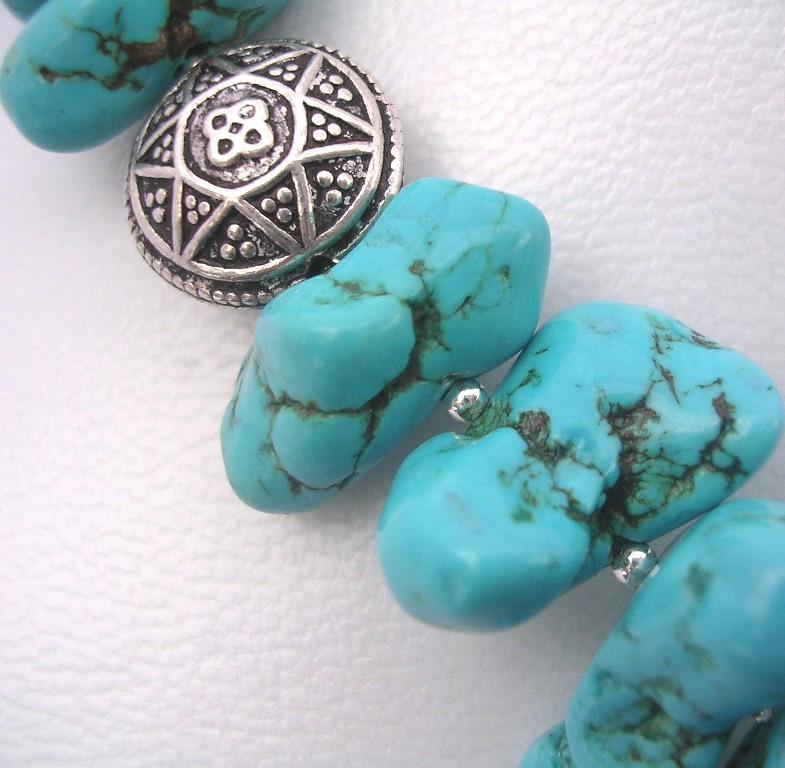
Treated blue turquoise from USA
Found in mostly arid regions it is mined in typically shallow excavations. A greenish turquoise was mined in Egypt 4000 years ago and is still found there occasionally. Persia became an important source of blue turquoise 2000 years ago and parts of Iran are still mined.

Natural green turquoise from the Kingman mine (USA) (with black spinel)
The southwest of the USA is well known for its turquoise (blue, bright green and yellow-green) and quite a few small scale mining operations continue. Among Native American peoples of the Southwest, turquoise is especially prized, with blue stones symbolizing "Father Sky" and greener ones evoking "Mother Earth."

Blue-green turquoise from China
China is also a large source of commercial turquoise these days although this tends to be in the blue-green, green and apple green colours. Turquoise is also found in Afghanistan, Australia, India, Chile and Turkestan.

Green turquoise from the Hubei district of China
Turquoise can change colour with time and handling – usually from absorbing moisture and oils from your skin.
After being mined for so many years, it is harder to obtain a nice quality natural turquoise. Instead, lower grades of turquoise are mined and these are usually treated to enhance the colour and to stablise the stones to make them harder and more robust. A traditional treatment is waxing and oiling.

A mix of treated blue and blue-green turquoise (as well as amazonite and aquamarine).
Low grade turquoise is called “chalk” turquoise – this is treated with permanent dyes and stabilisation procedures. Sometimes it is even ground down and rebuilt. This turquoise often has a lack of the typical veining and can come in numerous colours – lime and pink are popular new colours. Whilst still technically turquoise it has been fairly extensively altered.
The scarcity and cost of turquoise has also led to many imitations in the marketplace. Jasper, howlite and magnesite are three that are frequently colour treated. These are still natural gemstones – but treated to look like turquoise.

"African Turquoise" Jasper - dyed to look like turquoise yet still a gemstone in its own right when identified correctly.
Then there are synthetic imitations – made from porcelain, plastic, and various copper and aluminium compounds. Most of these synthetics will only bear a slim resemblance to natural turquoise.
If you have turquoise, it does require special care – it is sensitive to cosmetics and perfume which will damage the finish and may alter the colour. It can dehydrate and discolour if left in strong sunlight for a long period of time. So, put it on AFTER you’ve done your makeup/perfume/ sunscreen/hairspray and don’t wear in a beach/pool environment. Clean it with a soft cloth and store separately in its own bag or box to avoid scratching.

Another gemstone imitating turquoise - this is treated magnesite.
Lastly, buyer beware! If you like the colour and look of turquoise and decide to buy some, be sure to ask questions if descriptions are lacking or vague terms are used. A lot of affordable turquoise will be treated to some extent and this should be disclosed by reputable seller, jewellers and gemstone dealers.
Of course, this isn't an exhaustive dissertation on turquoise (!) but I hope I've covered the basics. If you have any specific questions about turquoise, post a comment and I'll get back to you!
Till next :)
Annette


